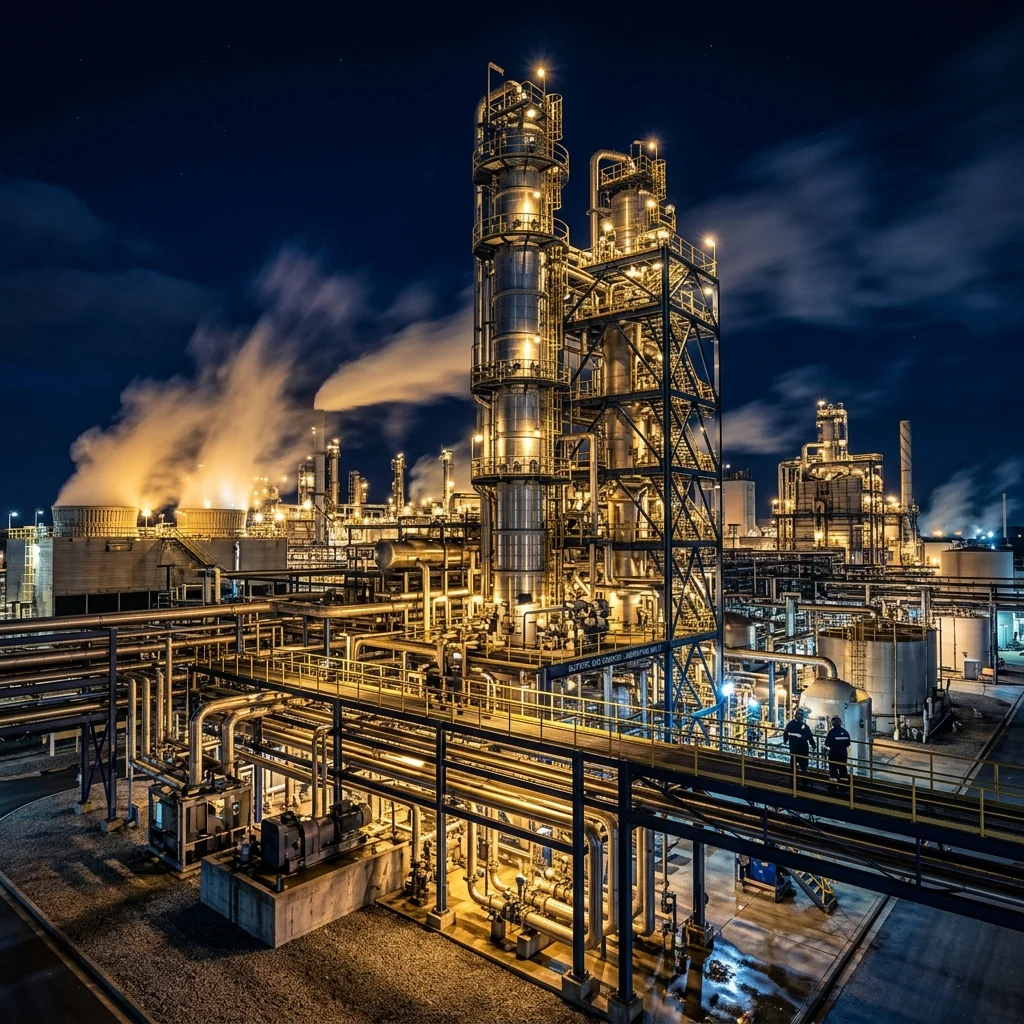
Sulfuric Acid
Technology Specialist

Sulfuric Acid — H₂SO₄

World-Class Sulfuric Acid Plant Commissioning, Refractory Curing & Steady-State Operations

1,500–3,000 MTPD
Typical Capacity
4-Pass Converter
Catalyst Beds
> 99.7%
Conversion Rate
1.2 t/t Acid
Steam Generation
Chemical Overview

Digesting the Chemistry & Industry Role

Sulfuric acid (H₂SO₄) is the world's most produced industrial chemical. It is the backbone of the fertilizer industry, used in the production of phosphoric acid, superphosphates, and ammonium sulfate. It is also essential in metallurgy, petroleum refining, and chemical synthesis.

Modern sulfuric acid plants use the contact process — catalytic oxidation of SO₂ to SO₃ over vanadium pentoxide catalyst, followed by absorption in concentrated acid. Plant capacities range from 100 to 5,000+ tonnes per day.

Managing a sulfuric acid facility requires extreme attention to detail in material selection, process temperature control, moisture ingress prevention, and catalyst activity monitoring to ensure safe, continuous, and highly efficient production.

Quick Reference Card
Chemical Formula
H₂SO₄
Classification
Strong Mineral Acid
Physical State
Liquid (Concentrated)
Primary Feedstock
Elemental SulfurAtmospheric OxygenProcess Water
Main Application
Phosphate Fertilizers, Metal Leaching, Chemical Synthesis
Process Flow

The Production & Conversion Sequence

01

Sulfur Combustion

Liquid sulfur is pumped, atomized, and burned with dry combustion air in the furnace to produce SO₂ gas at 10.5–11.5% concentration.

02

Gas Cooling

Hot furnace gases pass through a waste heat boiler, cooling the SO₂ gas stream to the catalyst activation temperature (~420°C).

03

Catalytic Conversion

SO₂ is oxidized to SO₃ inside a multi-bed converter containing V₂O₅ catalyst, with interbed cooling to maximize conversion.

04

Interpass Absorption

After the third catalyst pass, SO₃ is routed to the interpass tower where it is absorbed, shifting equilibrium for final conversion.

05

Final Absorption

The remaining SO₂ is converted in the fourth bed and absorbed in the final tower, achieving overall conversion rates exceeding 99.7%.

Major Infrastructure

Key Equipment & Machinery Assets

Sulfur Burner

High-temperature refractory-lined furnace designed for complete liquid sulfur atomization and combustion.

Waste Heat Boiler

Heavy-duty firetube or watertube boiler that recovers exothermic reaction heat to generate high-pressure steam.

Multi-Pass Converter

Stainless steel catalytic vessel containing vanadium pentoxide (V₂O₅) beds for sequential SO₂ to SO₃ conversion.

Double Absorption Towers

Packed columns with high-efficiency distribution systems for absorption of SO₃ into circulating 98.5% H₂SO₄.

Anodic Acid Coolers

Anodically protected shell-and-tube heat exchangers or alloy plate coolers managing highly corrosive acid loops.

Critical Risk Areas

Commissioning Challenges & Startup Risks

Hurdle 01

Converter catalyst activation requires precise temperature control — too cold and conversion is insufficient, too hot and catalyst is permanently damaged.

Hurdle 02

Acid mist formation in the absorption system is a common startup problem that requires careful attention to acid distribution, temperature, and flow rates.

Hurdle 03

The transition from startup to stable operation requires managing the heat balance across the entire plant — the converter is exothermic and the plant must be balanced before it can sustain itself.

Hurdle 04

Refractory drying and curing in the sulfur furnace must follow strict temperature ramp schedules to prevent cracking and structural failure.

Kafaah's Field Expertise

Operated. Started. Optimized.

Kafaah's team has 20 years of direct operational experience with sulfuric acid plants. We have operated contact process plants from startup through steady-state production.

Our experience spans single and double absorption configurations, with sulfur, pyrites, and metallurgical gas as feedstocks.

We provide comprehensive services from refractory dry-out supervision, cold and hot commissioning, gas-in startup protocols, and operator training to operational troubleshooting.

Request Technical Consult

Optimizing or Commissioning a Sulfuric Acid Plant?

Partner with specialized engineers who have directly operated and commissioned the exact same systems. Let's discuss your project targets.

Consult with our experts