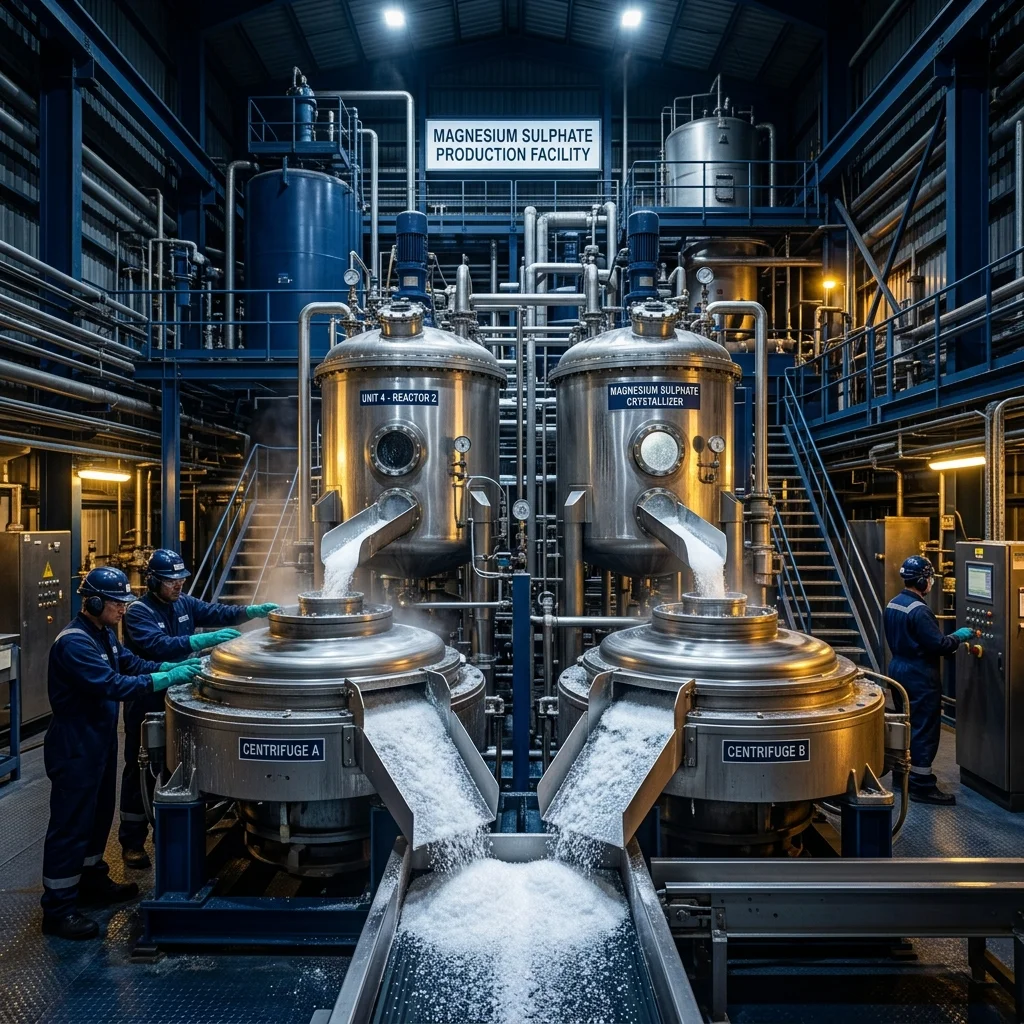
Magnesium Sulphate — MgSO₄
Magnesium Sulphate Reaction, Crystallization & Centrifugation Optimization Services
Digesting the Chemistry & Industry Role
Magnesium sulphate (MgSO₄) is produced in several hydrated forms, most commonly as epsomite (MgSO₄·7H₂O — Epsom salt). It serves agricultural, pharmaceutical, technical, and industrial applications.
Production routes include reaction of magnesium oxide or carbonate with sulfuric acid, extraction from natural mineral deposits, and as a byproduct of other chemical processes.
Maintaining high product quality requires meticulous crystallization control, mother liquor recovery optimization, and precise drying temperatures to prevent physical caking and crystal degradation.
The Production & Conversion Sequence
Reactant Digestion
Magnesium oxide (MgO) or magnesium carbonate is reacted with sulfuric acid in an agitated tank under controlled temperature (90-95°C).
Clarification & Filtration
The reactor slurry is clarified in a thickener and filtered through press filters to remove solid impurities, yielding a pure liquid filtrate.
Controlled Crystallization
The hot clear solution is fed to vacuum crystallizers where precise cooling prompts crystallization of heptahydrate (MgSO₄·7H₂O).
Crystal Centrifugation
The crystal slurry is fed into a continuous pusher centrifuge where the liquid phase is separated and recycled as mother liquor.
Low-Temp Drying
The wet crystals are dried in a fluid bed dryer at temperatures below 50°C to prevent stripping the heptahydrate's crystalline water.
Key Equipment & Machinery Assets
Magnesium Reactor
Agitated vessel lined with corrosion-proof material designed for highly exothermic magnesium-acid digestion.
Settling Clarifier
Clarification equipment separating unreacted ore residues and silica from the hot liquid sulfate.
Vacuum Crystallizer
Crystallization vessels controlling cooling rate and supersaturation to yield high-purity heptahydrate crystals.
Pusher Centrifuge
Mechanical dewatering centrifuge separating solid magnesium sulfate crystals from wet mother liquor.
Fluid Bed Dryer
Gentle low-temperature hot-air dryer removing surface moisture without decomposing hydration water.
Commissioning Challenges & Startup Risks
Hurdle 01
Crystal size and shape are controlled by crystallization parameters — temperature profile, supersaturation, and residence time.
Hurdle 02
Product moisture content must be precisely controlled during drying to prevent caking during storage.
Hurdle 03
Achieving pharmaceutical-grade purity requires careful attention to raw material quality and process water treatment.
Operated. Started. Optimized.
Kafaah's team has operational experience with magnesium sulphate production, including crystallization optimization and product quality management across agricultural and technical grades.
We help plants fine-tune their crystallization curves, troubleshoot centrifuge separator bottlenecks, and optimize fluid bed dryers to reduce product caking.
Related Advisory & Engineering Services
Commissioning & Startup
Pre-commissioning through performance testing. We have managed startup of H₂SO₄, H₃PO₄, K₂SO₄, NPK, MgSO₄, and SSP plants from cold to first product.
Technical Troubleshooting
Production loss, quality deviation, equipment failure. We have seen most problems before — and resolved them. Rapid diagnosis using chemical-specific methodology.
Production Optimization
Process audit, energy balance review, yield improvement, unit cost reduction. We measure before and after — results are not estimated, they are documented.
Optimizing or Commissioning a Magnesium Sulphate Plant?
Partner with specialized engineers who have directly operated and commissioned the exact same systems. Let's discuss your project targets.
Consult with our experts