NPK Compound Fertilizers
Seamless NPK Drum Granulation, Pipe Reactor Commissioning & Recipe Tuning
Digesting the Chemistry & Industry Role
NPK fertilizers are compound fertilizers containing nitrogen (N), phosphorus (P₂O₅), and potassium (K₂O) in various ratios tailored to crop and soil requirements. They are the backbone of modern agriculture.
NPK production methods include physical blending (dry mixing of individual fertilizers), chemical granulation (reaction-based), and compaction. Granulation produces a more uniform, dust-free product with better handling properties.
Commissioning an NPK granulation plant requires precise balancing of the solid recycle loop, reactor chemistry, slurry moisture, and raw material feed ratios to prevent line plugging and ensure high granule yield.
The Production & Conversion Sequence
Slurry Reaction
Liquid ammonia and acids (phosphoric and sulfuric) are injected into the pipe reactor, generating a hot chemical slurry melt.
Granule Agglomeration
The chemical slurry is sprayed onto a rolling bed of recycled fine solids in the granulator, layering and bonding solid salts.
Rotary Drying
Wet granules are sent to a rotary dryer, bringing moisture down below 1.5% to trigger crystallization and mechanical strength.
Screening & Classification
The cooled granules pass through double-deck screens. Product size is isolated; oversize is crushed and returned with undersize.
Conditioning & Coating
Target-sized granules are coated with a thin layer of oil and powder to ensure anti-caking during bagging and storage.
Key Equipment & Machinery Assets
Cross-Pipe Reactor
Chemical reactor executing inline neutralization of ammonia and acids to produce ammonium phosphate-sulfate melt.
Granulator Drum
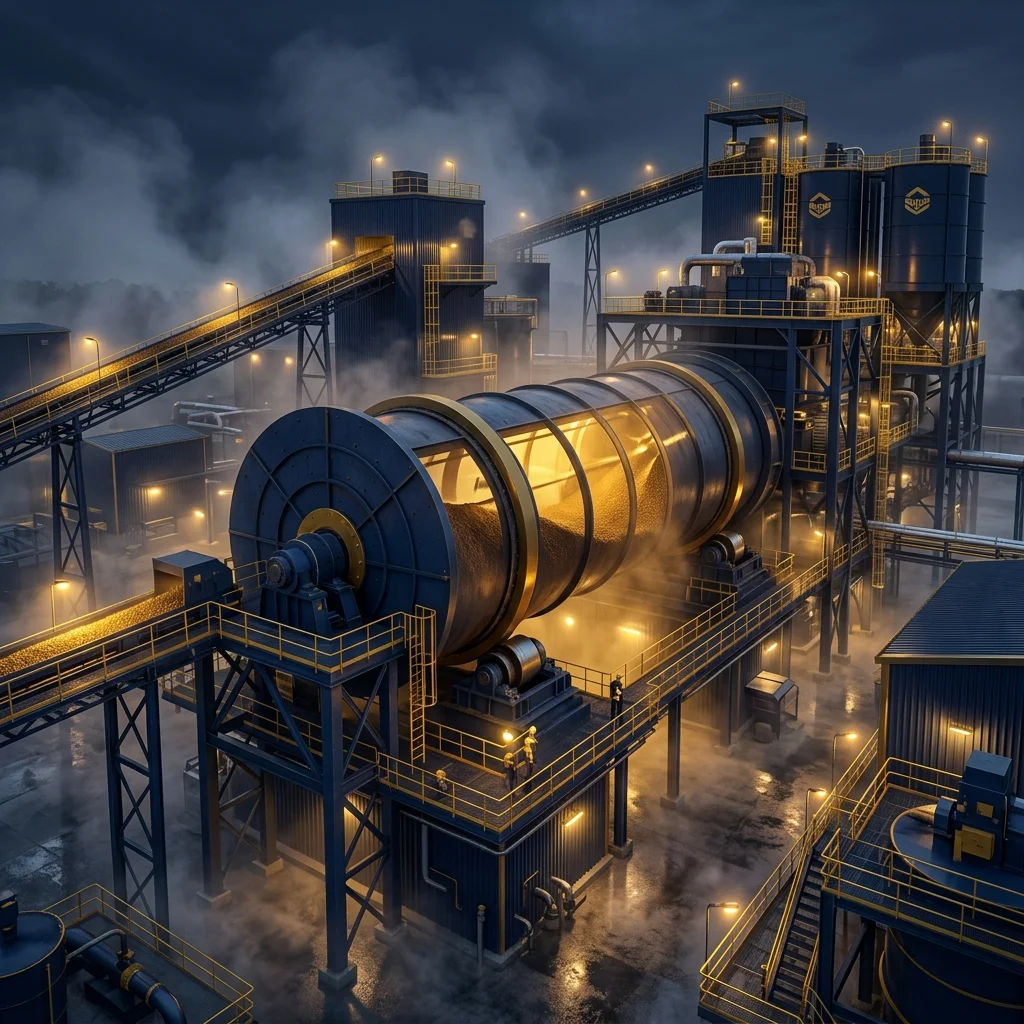
Rotary drum equipped with slurry spray headers, internal scraping, and solid product recycling bed.
Rotary Dryer & Cooler
High-volume air-flow rotary drums controlling granule moisture profile and mechanical hardening.
Vibrating Screen Classifiers
Double-deck high-frequency screens separating undersized, product-size, and oversized granules.
Coating & Conditioning Drum
Applies chemical anti-caking agent to the finished granules to prevent dust and storage clumping.
Commissioning Challenges & Startup Risks
Hurdle 01
Granulation is inherently unstable during startup — the recycle ratio must be established before steady-state operation is possible.
Hurdle 02
Dryer temperature and retention time must be optimized to achieve target moisture without damaging the granules or decomposing ammonium nitrate.
Hurdle 03
Screen performance and the recycle system determine product yield — poor classification leads to excessive recycle and capacity loss.
Hurdle 04
Dust and emissions control (scrubbing, cyclones) must be commissioned and optimized before production can reach full capacity.
Operated. Started. Optimized.
Kafaah successfully commissioned a large-scale NPK granulation unit in Yanbu Industrial City, Saudi Arabia (March 2026). This was our first GCC project — completed on schedule.
Our team managed the hot commissioning phase, stabilized the recycle loop, fine-tuned the chemical slurry formulation, and verified the anti-caking system performance.
We possess extensive operational knowledge in adjusting granulation recipes for 15-15-15, 18-18-5, and customized NPK formulations.
Yanbu Industrial NPK Granulation Unit
Led complete loop stabilization, chemical slurry recipe optimization, pipe reactor commissioning, and performance guarantee trials on-schedule for Kafaah's first GCC project.
Related Advisory & Engineering Services
Commissioning & Startup
Pre-commissioning through performance testing. We have managed startup of H₂SO₄, H₃PO₄, K₂SO₄, NPK, MgSO₄, and SSP plants from cold to first product.
Operation Readiness
Pre-startup review, HAZOP support, operating procedures, pre-commissioning checklists, staffing readiness, and safety systems verification.
Technical Troubleshooting
Production loss, quality deviation, equipment failure. We have seen most problems before — and resolved them. Rapid diagnosis using chemical-specific methodology.
Production Optimization
Process audit, energy balance review, yield improvement, unit cost reduction. We measure before and after — results are not estimated, they are documented.
Operator Training
Plant-specific training programs in Arabic and English. Developed by engineers who have operated these plants — not generic training consultants.
Optimizing or Commissioning a NPK Fertilizers Plant?
Partner with specialized engineers who have directly operated and commissioned the exact same systems. Let's discuss your project targets.
Consult with our experts